
Your website isn’t showing up on Google because search engines don’t understand what you offer or why it matters. SEO optimization fixes this disconnect, transforming your site from invisible to discoverable without requiring a technical background or massive budget.
The reality? Most beginners waste months chasing outdated tactics like keyword stuffing or buying backlinks, only to watch their rankings plummet. Meanwhile, businesses that focus on three foundational elements see measurable traffic increases within 30-60 days: creating content that answers specific customer questions, ensuring their website loads quickly and works on mobile devices, and earning genuine recommendations from other reputable sites.
SEO isn’t about gaming algorithms. It’s about making your business accessible to people actively searching for your products or services right now. Every day your site remains unoptimized, potential customers find your competitors instead. A local bakery owner recently increased online orders by 240% simply by adding location-specific keywords to service pages and claiming her Google Business Profile. An e-commerce entrepreneur doubled organic traffic in three months by fixing technical errors that prevented search engines from properly indexing product pages.
This guide eliminates confusion by breaking SEO into manageable steps you can implement this week, not someday. You’ll learn exactly which tasks deserve your attention, which deliver the fastest results, and when DIY efforts should transition to professional help. No confusing jargon. No expensive tools required upfront. Just proven strategies that work for businesses at your stage.

Why Most Beginners Get SEO Wrong (And How to Fix It)
Starting your SEO journey with misconceptions can waste months of effort and damage your website’s potential. Let’s address the most common mistakes so you can avoid them from day one.
The biggest trap beginners fall into is expecting overnight results. You launch your optimized website on Monday and check your rankings obsessively by Friday, wondering why you’re not on page one yet. Here’s the reality: SEO is a marathon, not a sprint. Most websites take 3-6 months to see meaningful improvements, and that’s with consistent effort. Search engines need time to crawl your site, evaluate your content, and determine where you belong in search results.
Keyword stuffing remains surprisingly common despite Google’s sophisticated algorithms. New website owners think repeating their target keyword 50 times will boost rankings. Instead, it creates awkward, unreadable content that both visitors and search engines reject. Modern SEO focuses on natural language and topic coverage rather than keyword density.
Perhaps the most costly mistake is ignoring user intent. You might rank for “affordable running shoes,” but if searchers want buying guides and you’re offering product pages, they’ll bounce immediately. High bounce rates signal to Google that your content doesn’t match what people actually need, pushing you down in rankings.
Another misconception is that SEO is purely technical. While site speed and mobile optimization matter, they’re table stakes. The businesses seeing real growth invest in genuinely helpful content that answers customer questions and solves real problems.
Many beginners also neglect their existing customers as content resources. Your clients already told you what they struggled with before finding you. Those pain points are exactly what potential customers are searching for online. One small business owner I worked with doubled their organic traffic simply by turning their most frequently asked customer questions into blog posts.
The fix? Start with realistic timelines, focus on creating valuable content for humans first, and remember that SEO serves your business goals, not the other way around.
The Foundation: Understanding How Search Engines See Your Website
What Google Actually Looks For
Google’s search algorithm evaluates hundreds of factors, but three core elements drive most ranking decisions: relevance, authority, and user experience.
Relevance means your content genuinely answers what people are searching for. Google analyzes your page content, titles, headings, and images to determine if you’re addressing the search query. For example, if someone searches “best running shoes for flat feet,” Google wants to show pages that specifically discuss running shoes designed for that foot type, not just general athletic footwear. Your job is to create content that directly matches the search intent behind the keywords you’re targeting.
Authority reflects how trustworthy and credible your website appears. Google measures this primarily through backlinks from other reputable websites pointing to yours. Think of backlinks as votes of confidence. When established industry websites link to your content, it signals to Google that your information is valuable and reliable. However, quality matters more than quantity. Ten links from respected sources in your industry carry more weight than a hundred links from random, low-quality websites.
User experience encompasses how people interact with your site. Google tracks metrics like page loading speed, mobile-friendliness, time spent on page, and bounce rate. If visitors immediately leave your site because it loads slowly or looks broken on their phone, Google interprets this as a signal that your page doesn’t satisfy users. Making your website fast, mobile-responsive, and easy to navigate directly impacts your rankings.
Understanding these three pillars helps you prioritize your SEO efforts effectively and build a sustainable strategy.
The Three-Second Test Your Site Must Pass
When someone lands on your website, you have roughly three seconds before they decide to stay or hit the back button. Search engines know this, which is why they prioritize sites that pass this critical first-impression test.
Page speed is your first hurdle. If your site takes longer than three seconds to load, you’re losing both visitors and rankings. Use Google’s free PageSpeed Insights tool to check your current speed and get specific recommendations. Simple fixes like compressing images and enabling browser caching can make an immediate difference.
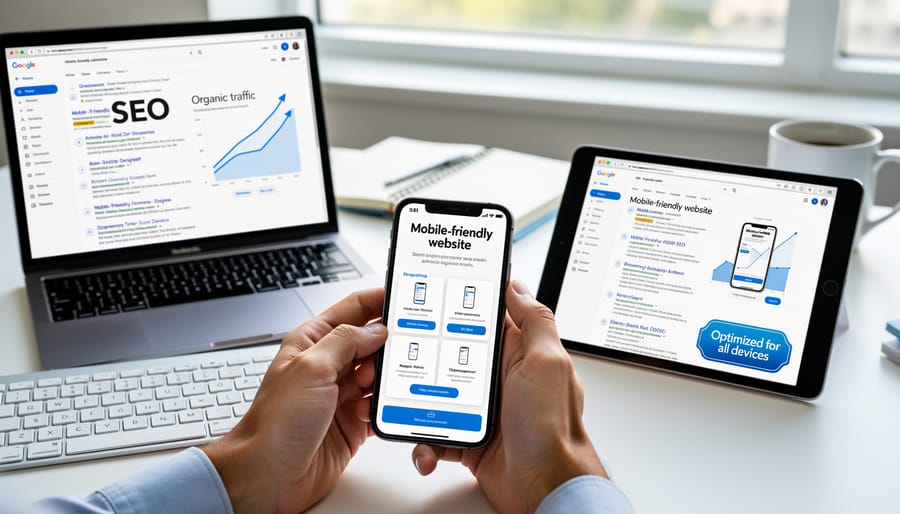
Mobile-friendliness isn’t optional anymore. Over 60% of searches happen on mobile devices, and Google uses mobile-first indexing, meaning it primarily looks at your mobile site for ranking decisions. Test your site with Google’s Mobile-Friendly Test tool. If text is too small to read or buttons are too close together, you’re failing this test.
Your visual presentation matters too. A cluttered, outdated design signals low credibility to both users and search engines. Your homepage should clearly communicate what you offer within seconds, with easy navigation and a clear call-to-action visible without scrolling.
Keyword Research That Actually Brings Customers
Finding Keywords Your Competitors Miss
You don’t need expensive software to find valuable keywords your competitors are overlooking. Start with Google’s free Keyword Planner, which shows search volume and competition levels for terms related to your business. For example, a local bakery might discover that “gluten-free birthday cakes in [city name]” has decent search volume but low competition, while everyone else targets the saturated “best bakery” keywords.
AnswerThePublic is another free tool that reveals questions people actually ask about your products or services. An e-commerce store selling yoga mats could uncover long-tail keywords like “how thick should a yoga mat be for bad knees” that competitors ignore but potential customers are actively searching for.
Google Search Console, free once you verify your website, shows which keywords already bring you traffic and reveals opportunities you’re ranking for on page two or three. These are low-hanging fruit where small improvements can yield big results.
For budget-conscious businesses, Ubersuggest offers a free tier with limited daily searches, providing keyword ideas and difficulty scores. Look for keywords with search volumes between 100-1,000 monthly searches and lower difficulty ratings. These “Goldilocks keywords” are realistic targets for beginners.
The real advantage comes from thinking like your customers, not your competitors. What specific problems do they need solved? A pool cleaning service discovered “green pool emergency fix” outperformed generic “pool cleaning services” because it matched urgent customer needs. Focus on solving real problems, and you’ll naturally find keywords others miss.
Local vs. Broad: Choosing the Right Battle
Your keyword strategy depends entirely on how customers find you. If you run a pizza shop, dentist office, or home repair service, local keywords are your goldmine. Target phrases like “pizza delivery Chicago” or “emergency plumber Austin” instead of broad terms like “best pizza” or “plumbing services.” Local searches convert at significantly higher rates because people are ready to buy right now.
For e-commerce stores or service providers working nationwide, broader keywords make sense. An online jewelry store benefits from “handmade silver earrings” more than “jewelry store near me.” However, even broad-focused businesses can leverage local SEO if they have physical locations or service specific regions.
Start by asking: Does my customer need to be nearby? If yes, prioritize local keywords with city or neighborhood names. If no, focus on product-specific or problem-solving keywords that match what people type when they’re researching solutions.
Many businesses benefit from both approaches. A marketing consultant might target “SEO consultant Boston” for local clients while also ranking for “small business marketing strategies” to attract remote customers. Test both strategies using Google Search Console to see which drives more qualified leads for your specific business model.
Where to Place Keywords Without Sounding Robotic
The key to natural keyword placement is thinking like your customer, not a search engine. Start with your page title and first paragraph—your primary keyword should appear here naturally. For example, if you’re targeting “handmade leather wallets,” your title might be “Handmade Leather Wallets: Crafted for Everyday Carry.”
Sprinkle keywords throughout your headings (H2s and H3s) where they fit the topic flow. In your body content, focus on answering questions your customers actually ask. This naturally incorporates related terms without forcing repetition.
Your meta description deserves attention too—include your main keyword once while writing a compelling reason to click. Think of it as your elevator pitch in 155 characters.
The golden rule: read your content aloud. If it sounds awkward or repetitive, your customers will notice before Google rewards you. Write for humans first, optimize for search engines second. When you prioritize clarity and helpfulness, keywords fall into place naturally, and your content serves both your audience and your SEO goals.

Content That Ranks and Converts
The Content Formula That Works for Small Businesses
Creating content that ranks well doesn’t require a marketing degree. Start with the problem-solution framework: identify a specific challenge your customers face, then provide a clear answer backed by your expertise. For example, instead of writing “Our plumbing services,” create content titled “How to Stop a Leaking Faucet in 5 Minutes.”
Focus on the 3 E’s: educate, engage, and encourage action. Every piece should teach something valuable, maintain a conversational tone that keeps readers interested, and include a clear next step whether that’s contacting you, downloading a guide, or reading another article.
Structure your content for both humans and search engines. Use short paragraphs of 2-3 sentences maximum. Include your target keywords naturally in the first paragraph and throughout the content, but write primarily for people. Answer the question thoroughly within the first 300 words, then expand with supporting details.
The sweet spot for most small business content sits between 800-1,500 words. This length allows you to cover topics comprehensively without overwhelming readers or consuming too much of your time. One well-researched article published monthly outperforms four thin, rushed posts every time.
Include real examples from your business. If you’re a local bakery, share the story behind your sourdough recipe. Authenticity resonates with both customers and search engines, which increasingly prioritize unique, first-hand content over generic information anyone could write.
How Often Should You Actually Post?
There’s no magic number, but quality always trumps quantity. For most small businesses just starting with SEO, one well-researched, comprehensive blog post per week is far more valuable than daily mediocre content.
Here’s a realistic framework based on your resources:
If you’re a solopreneur with limited time, aim for 2-4 posts monthly. Focus on thoroughly answering one customer question per post with 1,000-1,500 words of genuinely helpful content.
If you have a small team or dedicated marketing person, target one post weekly (4-5 monthly). This allows time for proper keyword research, quality writing, and optimization.
If you’re working with an agency or have robust in-house resources, 2-3 posts weekly can accelerate results, provided each maintains high standards.
Consider Sarah, who runs an online pet supply store. She started posting once weekly, creating detailed guides like “Complete Nutrition Guide for Senior Dogs” instead of thin product descriptions. Within six months, her organic traffic increased 340%, and three of her articles now rank on page one for competitive keywords.
The key is consistency over frequency. Search engines reward sites that publish regularly on a predictable schedule. Choose a pace you can maintain for the long haul without burning out or sacrificing quality. Remember, one exceptional article that earns backlinks and satisfies search intent beats ten rushed posts that nobody reads or shares.
Technical SEO Made Simple
Five Technical Fixes You Can Do Today
Technical SEO doesn’t have to be intimidating. Here are five straightforward fixes you can implement today to improve your search rankings, even with zero coding experience.
Start with your meta tags. Every page needs a unique title tag (50-60 characters) and meta description (150-160 characters) that includes your target keyword. Think of these as your storefront window display—they’re what searchers see first in Google results. For example, instead of “Home | ABC Company,” try “Handmade Leather Bags | Free Shipping | ABC Company.”
Next, optimize your images. Large image files slow down your site, which Google penalizes. Before uploading any image, compress it using free tools like TinyPNG. Always add descriptive alt text that explains what’s in the image—this helps search engines understand your content and improves accessibility.
Review your site structure to ensure visitors can reach any page within three clicks from your homepage. Create a logical hierarchy with clear categories and subcategories. This helps both users and search engines navigate your content efficiently.
Generate and submit an XML sitemap through your website platform or a plugin like Yoast SEO. This file tells Google which pages exist on your site and how they’re organized. Submit it through Google Search Console to speed up the indexing process.
Finally, switch to HTTPS if you haven’t already. Most web hosts offer free SSL certificates. That padlock icon in the browser bar isn’t just about security—Google confirmed it’s a ranking factor. Contact your hosting provider today; most can enable HTTPS in under an hour.
These five fixes typically take 2-3 hours total but deliver measurable improvements within weeks.
When to Call in Professional Help
Most beginners can successfully handle foundational SEO tasks like keyword research, content creation, and basic on-page optimization. You’re capable of implementing the strategies outlined in this guide, especially during your first few months of learning.
However, consider professional assistance when you encounter technical challenges beyond your comfort level. If your website has persistent indexing issues, requires complex schema markup implementation, or needs a comprehensive site migration, expert help prevents costly mistakes. Similarly, if you’ve invested three to six months without seeing meaningful traffic improvements, a professional audit can identify blind spots in your strategy.
Time is another crucial factor. As a business owner, calculate whether the 10-15 hours weekly needed for effective SEO delivers better ROI than focusing on your core business while experts handle optimization. Many entrepreneurs find a hybrid approach works best: learning fundamentals themselves while outsourcing technical audits, link building campaigns, or competitive analysis.
The right time to seek help is before problems become crises. If you’re planning a website redesign, launching in a competitive market, or scaling rapidly, professional guidance from the start saves both time and money.
Building Authority Without a Massive Budget
Building authority in your industry doesn’t require deep pockets—it requires strategic thinking and consistent effort. For beginners, the goal is simple: show Google and potential customers that your business is trustworthy and relevant.
Start with guest posting on industry blogs and local publications. Reach out to complementary businesses or community websites with article ideas that genuinely help their audience. A plumbing company might write about “Preparing Your Home for Winter” for a local real estate blog. Each guest post typically includes a link back to your site, signaling to search engines that others vouch for your expertise. The key is quality over quantity—one link from a respected local news site beats ten from random directories.
Local partnerships offer another powerful opportunity. Sponsor a community event, join your chamber of commerce, or collaborate with neighboring businesses on a promotion. These relationships often result in natural backlinks from their websites plus real-world visibility. A local coffee shop that partners with a nearby bookstore for author readings gains links, foot traffic, and community goodwill simultaneously.
Social proof builds authority without any budget at all. Actively request reviews on Google Business Profile, Yelp, and industry-specific platforms. Display customer testimonials prominently on your website. Search engines factor reviews into local rankings, and potential customers trust peer recommendations more than any marketing message you could craft.
Create shareable resources like checklists, templates, or guides specific to your industry. A landscaping company might develop a seasonal maintenance calendar that local bloggers and homeowners naturally want to link to and share. When your content solves real problems, links happen organically.
Finally, engage authentically on social media and relevant online forums. Answer questions in Facebook groups, LinkedIn discussions, or Reddit communities without being salesy. Include your website in your profile, and let helpful contributions drive curious readers to learn more. Authority grows when you consistently demonstrate expertise where your audience already gathers.
Measuring What Matters: SEO Metrics for Business Owners
The Only Five Metrics You Need to Track
Tracking the right metrics helps you understand what’s working and where to focus your efforts. Here are the five essential SEO metrics every beginner should monitor:
Organic Traffic measures how many visitors find your website through search engines. This is your primary success indicator. If this number grows month-over-month, your SEO efforts are paying off. Use Google Analytics to track this under Acquisition > All Traffic > Channels > Organic Search.
Conversion Rate shows the percentage of visitors who complete desired actions, whether that’s making a purchase, filling out a contact form, or signing up for your newsletter. A local bakery client increased their organic traffic by 150% but only saw a 20% sales increase because they tracked conversions and optimized their checkout process accordingly.
Keyword Rankings reveal where your pages appear in search results for target keywords. Track 10-15 core keywords that matter most to your business. Tools like Google Search Console show which queries bring you traffic and your average position.
Bounce Rate indicates the percentage of visitors who leave after viewing just one page. High bounce rates often signal mismatched content or poor user experience. Aim for under 60% on key landing pages.
Page Load Time directly impacts both rankings and user experience. Google prioritizes fast-loading sites, and visitors abandon pages that take longer than three seconds to load. Use Google PageSpeed Insights to identify and fix speed issues.
Focus on improving one metric at a time for manageable, measurable progress.
Real Results: How One Client Grew Traffic by 240%
Meet Sarah Chen, owner of a boutique home decor store in Portland. Like many small business owners, she felt overwhelmed by SEO and had been putting it off for months. Her website attracted barely 200 visitors monthly, and most sales came from word-of-mouth referrals.
In January 2023, Sarah decided to tackle SEO herself using the exact techniques outlined in this guide. She started with keyword research, focusing on long-tail terms like “handmade ceramic planters Portland” instead of impossible-to-rank terms like “home decor.” Next, she optimized her product pages with descriptive titles and detailed descriptions that answered customer questions.
Within 30 days, her traffic increased by 45%. By month three, she was seeing 680 monthly visitors—a 240% increase. More importantly, her online sales doubled.
“I thought SEO was only for tech experts,” Sarah says. “But breaking it down into small, manageable steps made all the difference. I spent just 2-3 hours weekly, and the results spoke for themselves.”
Sarah’s success wasn’t overnight magic—it was consistent effort applied to proven fundamentals. Your results may vary based on your industry and competition, but the principles remain the same.
Your 30-Day SEO Action Plan
Starting your SEO journey doesn’t have to feel overwhelming. Here’s a practical roadmap to guide your first month, broken into manageable weekly tasks that build upon each other.
Week 1: Foundation and Research
Begin by installing Google Analytics and Google Search Console on your website. These free tools provide essential data about your site’s performance. Next, conduct keyword research for your top three products or services using free tools like Google Keyword Planner or Ubersuggest. Document 5-10 keywords with reasonable search volume and low to medium competition. Finally, audit your existing website content to identify which pages need optimization first.
Week 2: On-Page Optimization
Focus on optimizing your homepage and three most important service or product pages. Update title tags to include your primary keywords while keeping them under 60 characters. Write compelling meta descriptions that encourage clicks. Ensure each page has a clear H1 heading that incorporates your target keyword naturally. Review your content to confirm it answers the questions your customers are actually asking.
Week 3: Technical Improvements and Content
Check your website’s mobile responsiveness using Google’s Mobile-Friendly Test. Address any loading speed issues by compressing images and removing unnecessary plugins. Create one new blog post targeting a specific keyword from your research, aiming for 800-1,000 words of genuinely helpful content. Make sure all images have descriptive alt text.
Week 4: Building Authority
Claim and optimize your Google Business Profile with accurate information, photos, and your first posts. Reach out to three industry-related websites or local business directories for potential backlink opportunities. Set up a simple monthly reporting routine to track your keyword rankings and organic traffic growth. Document what’s working so you can replicate your successes moving forward.
SEO success doesn’t happen overnight, but the good news is that you don’t need to be an expert to start making progress. The strategies outlined in this guide can help you build a strong foundation that delivers real results over time. Remember, even small, consistent improvements add up. Google rewards websites that demonstrate ongoing commitment to quality content and user experience.
Start with the basics today. Choose one or two techniques from this guide and implement them this week. Perhaps optimize your title tags, improve your page loading speed, or publish one well-researched blog post. These initial steps create momentum that makes the next actions easier.
While DIY SEO is entirely possible for motivated beginners, there’s no shame in seeking expert guidance when you need it. Sometimes having experienced professionals handle the technical complexities allows you to focus on running your business. If you’re looking for specialized support to accelerate your results, I-SEO offers tailored solutions designed for businesses at every stage of their optimization journey.
The most important decision you can make right now is to simply begin. Your competitors are already investing in SEO. Every day you wait is another day they’re capturing traffic that could be yours. Take that first step today.